Paris-Nice 2026 Course Analysis: Who Will Conquer the Diverse Stages?
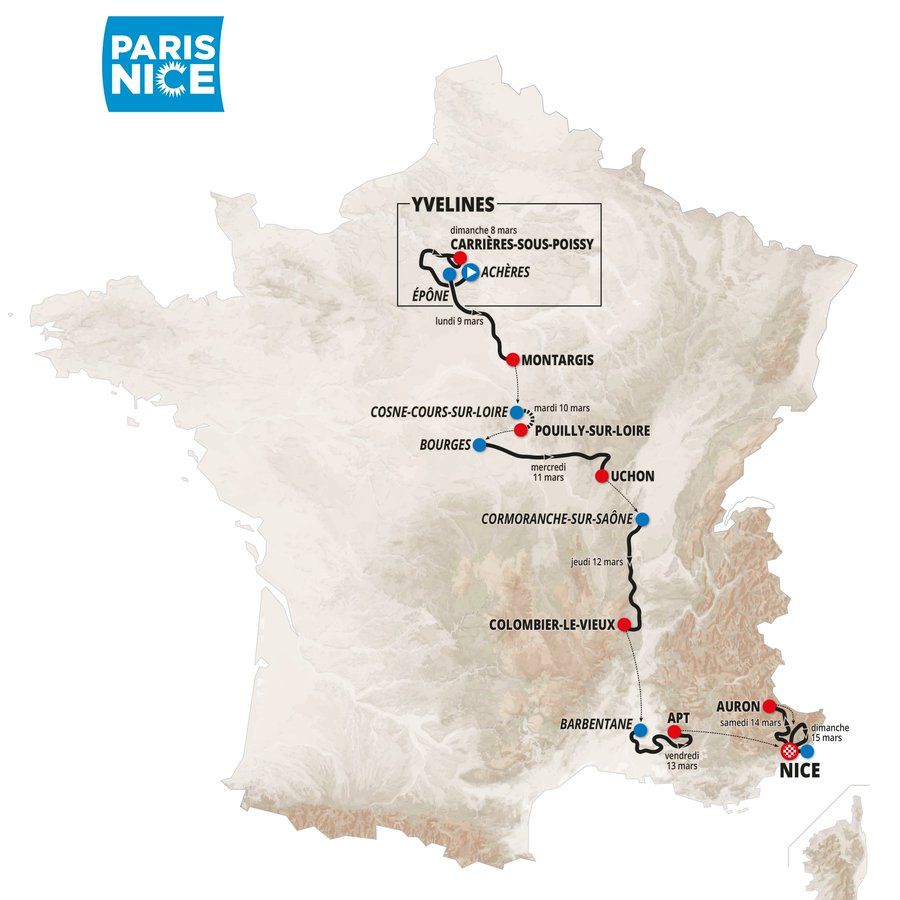
The prestigious "Race to the Sun," Paris-Nice, returns for its 84th edition from Sunday, March 8th, to Sunday, March 15th, 2026, promising a week of intense racing across a meticulously crafted `parcours paris-nice 2026`. This early-season stage race is a crucial test for the peloton, offering a challenging blend of terrains designed to crown a truly versatile champion. With eight demanding stages spanning 1,245 kilometers from Achères in the Yvelines to the sunny Côte d'Azur, the route mixes tradition with innovative challenges, ensuring that general classification (GC) contenders must be alert from day one.
Organizers have devised an itinerary that is faithful to the DNA of Paris-Nice: stages exposed to the risk of crosswinds (bordures), a pivotal team time trial, punchy finishes, and arduous hilly and mountainous days. As one of the first major stage races of the professional cycling calendar, it's a vital proving ground for riders eyeing Grand Tours and Monuments later in the season. A strong performance here can set the tone for the entire year. For a more complete overview, you can delve into the
Paris-Nice 2026: Full Route, Dates & Stage Profiles Revealed.
The 2026 `Parcours Paris-Nice`: A Test of All-Round Talent
The 2026 edition of Paris-Nice is structured to progressively challenge the peloton, ensuring that only the most complete riders can contend for the coveted yellow jersey. Twenty-two teams will line up at the start: the 18 UCI WorldTour formations, joined by the three best UCI ProTeams from the 2025 season – Cofidis, Pinarello-Q36.5 Pro Cycling Team, and Tudor Pro Cycling Team – plus a wildcard invitation extended to the French outfit Team TotalEnergies. This competitive field guarantees thrilling action across every stage.
The `parcours paris-nice 2026` is a deliberate diagonal journey across France, designed to stress-test every facet of a rider's capabilities. From the opening gambits in the north to the climbing challenges further south, each day presents unique obstacles. Unlike some races that favor pure climbers or sprinters, Paris-Nice traditionally demands an all-rounder – someone who can time trial, handle the high mountains, sprint from a reduced group, and navigate tricky, windy plains with equal prowess. The defending champion, Matteo Jorgenson, who has triumphed in the last two editions, exemplifies this multi-faceted skill set.
Early Battles: Sprints, Punchers, and the Crucial Team Time Trial
The initial stages of Paris-Nice 2026 lay the groundwork for the general classification, offering opportunities for different rider types while subtly chipping away at the GC hopefuls.
Stage 1: The Punchy Start in Yvelines (Achères > Carrières-sous-Poissy, 171.2 km)
The 84th edition kicks off from Achères, marking the 30th time the Yvelines department has hosted a stage of the "Race to the Sun." This opening day, on Sunday, March 8th, is anything but a ceremonial ride. The 171.2-kilometer route concludes with an exacting circuit around the finish line in Carrières-sous-Poissy. The critical point will undoubtedly be the formidable Côte de Chanteloup-les-Vignes, a sharp ascent of 1.1 kilometers at a demanding 8.3%. This short, steep climb, strategically placed near the finish, is tailor-made for powerful puncheurs. It presents an early opportunity for aggressive riders to claim the first yellow jersey and for GC contenders to demonstrate their form and avoid any early time losses. Expect fireworks and perhaps a fragmented peloton as riders battle for position before and over this decisive climb.
Stage 2: Sprinters' Paradise or Wind-Swept Chaos? (Épône > Montargis, 187 km)
Monday, March 9th, brings a more traditional stage for the fast men of the peloton. Covering 187 kilometers from Épône to Montargis, this stage is predominantly flat, traversing the open plains of the Beauce region. On paper, it's a classic mass sprint finish. However, the flat, exposed terrain carries a significant caveat: wind. The notorious crosswinds, or "bordures," are a constant threat in Paris-Nice. If the wind picks up, this seemingly innocuous stage could transform into a tactical nightmare, splitting the peloton into echelons and causing significant time gaps among GC favorites who are caught on the wrong side. Teams with strong lead-out trains will not only be protecting their sprinters but also their GC leaders, ready to join the fight for position if the wind dictates.
Stage 3: The Strategic Team Time Trial (Cosne-Cours-sur-Loire > Pouilly-sur-Loire, 23.5 km)
Tuesday, March 10th, introduces a pivotal stage in the form of a 23.5-kilometer team time trial (TTT) between Cosne-Cours-sur-Loire and Pouilly-sur-Loire. This discipline, making a return to Paris-Nice in this format, will be instrumental in shaping the general classification. The parcours is described as relatively flat, emphasizing raw power, synchronization, and aerodynamic efficiency. Strong teams with robust engines will gain valuable time on their rivals, while weaker teams or those with less cohesion could see their GC ambitions take a significant hit. The TTT is a true test of a team's collective strength and strategy. With the Grand Départ of the Tour de France 2026 set for Barcelona, this TTT also serves as an excellent early-season rehearsal for teams aiming for success in the July classic. You can find more specific details on the various stage types in
Paris-Nice 2026: Team Time Trial, Mountain & Sprint Stages Detailed.
Heading South: The Mountains Emerge
As the race progresses, the terrain shifts, moving away from the relatively flat lands of the north and venturing into the more undulating and eventually mountainous regions, where the true climbers and GC strongmen will come to the fore.
Stage 4: Morvan's Deceptive Hills (Bourges > Uchon, 195 km)
On Wednesday, March 11th, the peloton heads towards the challenging roads of the Morvan region. This 195-kilometer stage from Bourges to Uchon should not be underestimated. Its final kilometers feature two significant ascensions that will undoubtedly animate the race. First, the Côte de la Croix de la Libération, a 4.6-kilometer climb averaging 5.3%, provides a solid warm-up. This is immediately followed by the decisive final ascent to Uchon. This 8-kilometer climb averages 4.5% but is characterized by its irregular gradient, becoming significantly steeper in its latter sections. Uchon made a memorable appearance in the Tour de France 2021, and its challenging profile ensures that strong climbers and powerful puncheurs will be battling for the stage victory and valuable seconds. This is the first genuine test in the hills where climbers can start to make their mark on the `parcours paris-nice 2026`.
Stage 5: The Queen Stage Contender (Cormoranche-sur-Saône > Colombier-le-Vieux, 205.4 km)
Thursday, March 12th, presents arguably the most demanding stage of the race, a potential queen stage in terms of elevation gain. The 205.4-kilometer route from Cormoranche-sur-Saône to Colombier-le-Vieux promises relentless climbing. This stage features the highest positive elevation gain of the entire 2026 edition. The real action will unfold in the final 40 kilometers, which are punctuated by no less than four steep ascents. This brutal sequence of climbs will severely test the legs and resolve of every GC contender. Riders who thrive on sustained, steep gradients will be in their element here, as significant time gaps are expected. This is where pure climbers must attack and try to build a lead, while all-rounders will need to dig deep to limit their losses. It’s a day for strong teams to support their leaders and for decisive moves to be made.
What to Expect from the Unveiled Stages & Who Will Conquer?
While full details for Stages 6, 7, and 8 of the Paris-Nice 2026 have yet to be revealed, history and tradition suggest what might lie ahead for the conclusion of the "Race to the Sun." Typically, the final weekend of Paris-Nice features more challenging mountain stages, often culminating in a decisive climb near Nice, such as the Col de la Madone or a similar ascent that can dramatically reshuffle the GC. The penultimate stage often sets up the grand finale, with the final day usually a shorter, explosive stage around Nice itself, featuring a series of sharp, undulating climbs that offer a last chance for riders to make a move. Given the team time trial earlier in the week, it's less likely we'll see an individual time trial in the final stages, but punchy hill-top finishes or incredibly technical descents towards Nice are always on the cards.
Who will conquer this diverse `parcours paris-nice 2026`? The design clearly favors an exceptional all-rounder. Riders like Matteo Jorgenson, who possess strong time trial capabilities, excellent climbing legs, and the tactical acumen to navigate crosswind sections, will be top contenders. Individuals who can deliver consistent performances across multiple disciplines are essential. Puncheurs with climbing prowess will excel in stages like Uchon and the opening stage, while pure climbers will look to Stage 5 and potential later mountain stages to make their decisive moves. Team support will also be paramount, especially in the TTT and in the fight for position on windy or technical days. The ability to stay focused, conserve energy, and seize every opportunity will be key to donning the yellow jersey on the Promenade des Anglais.
Conclusion
The `parcours paris-nice 2026` promises a thrilling and unpredictable week of racing, firmly establishing it as one of the most compelling early-season stage races. From the punchy start in Yvelines to the strategic team time trial, the treacherous wind-swept plains, and the demanding climbs of the Morvan and Rhône-Alpes regions, every stage offers a unique challenge. This 84th edition of the "Race to the Sun" is designed to test every facet of a professional cyclist's skill set, ensuring that only the most complete and resilient rider will ultimately conquer its diverse stages and claim victory in Nice. It’s a spectacle not to be missed for any cycling enthusiast.